
Field Journal Entry - 3 July, 2026
Field Journal — Presque Isle, Erie, Pennsylvania
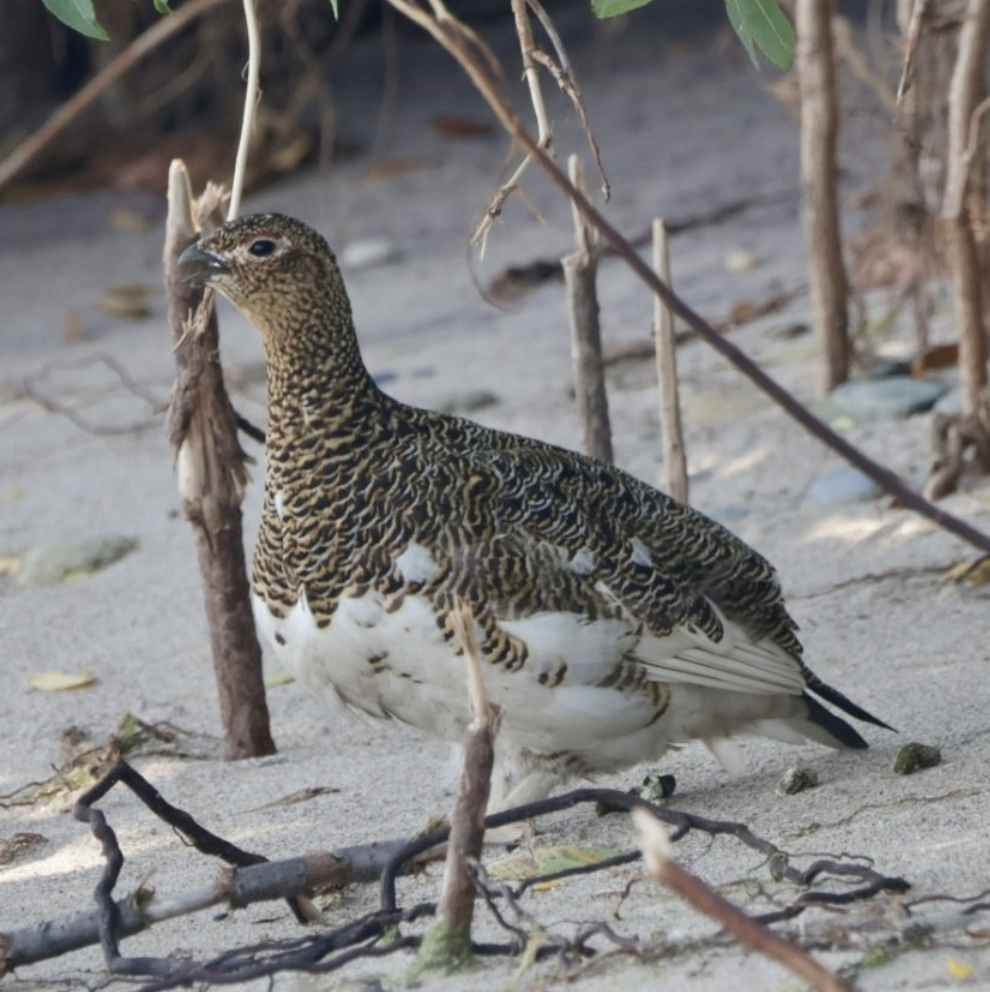
Our trip began early in the pre-dawn darkness in southeast PA, a six hour drive away from the northwest corner of PA. The goal of this grand day trip was to see a Willow Ptarmigan that had landed itself at Presque Isle State Park in Erie.
The walk to the point began early in the day, but the heat was already growing. It was a welcome exercise after the six hour car ride from Berks county. Heat shimmered above the sand dancing the light around and making a dip into the lake almost too tempting. The chase was on, and the bird came first. Word had spread that a Willow Ptarmigan (a bird of Arctic tundra and boreal landscapes) had somehow found its way to Presque Isle, in Erie PA!
A bird built for snow, standing quietly on sunbaked sand.
The contrast was difficult to ignore.
The Willow Ptarmigan survives winters that most creatures avoid. Feathered feet carry it across drifts, and its plumage changes with the seasons to match a world of white and stone. Yet today it stood beneath an unforgiving Pennsylvania sun, thousands of miles from the landscape that shaped its existence.
It wasn't the only one struggling with the heat. The many birders that had come excited to catch a glimpse of a bird they would not likely be able to see without a big trip up north, were frying in the heat and humidity.
As the day wore on, emergency responders were called to assist multiple birders who had made the long trek to the point. Several suffered heat-related illnesses and required rescue after underestimating the conditions. We had all come seeking the same improbable encounter, but the weather reminded us that nature always sets the terms.
It's tempting to dismiss this as coincidence…a northern bird appearing during an intense heat wave. Chance certainly plays its part in migration, storms, and wandering individuals. Yet the backdrop against which these stories unfold is changing. Summers grow hotter, with more frequent and larger storms. Heat waves arrive more frequently, and with them record temperatures and wildfires with unsettling regularity. Climate is the stage upon which chance performs, and that stage is shifting beneath our feet.
Whether this ptarmigan's journey was driven by weather, disorientation, or simple accident, its presence felt almost symbolic: a creature evolved for cold standing in oppressive heat while people crossed a sweltering landscape just to witness it.
Birding has always been an exercise in embracing improbability. Some days, the rare bird never appears. Many birding adventures reveal only familiar, albeit cherished, feathered companions. Then, without warning, something extraordinary enters your life for a moment before disappearing again.
Perhaps that is why these encounters linger in our memory.
Life is measured less by certainty than by the unexpected moments that interrupt it…a bird far from home, a conversation with a stranger on a trail, the decision to take one more path instead of turning back. We spend much of our lives searching for remarkable things, but they often arrive unannounced, asking only that we were present enough to notice.
The Willow Ptarmigan was seen for a while longer, after our interaction with her, before she disappeared. Years from now, the checklist will remain, photographs will circulate, and the date will become another line in a record book, and more importantly a memory cherished by the many birders that met her.
What I suspect I'll remember instead is the heat, and the strange feeling of watching an Arctic bird endure a summer afternoon in Pennsylvania, while a gathering of people, equally out of their element, were moved by a unlikely encounter. A strong reminder that the natural world is still capable of astonishing us, and worth fighting to protect.
That’s a WRAP - Berks Big Day - 9 May 2026
A Big Day is one of birding's best traditions. It is the challenge of finding and identifying as many bird species as possible within a single calendar day from midnight to midnight. Success depends on careful planning, knowledge of local habitats, favorable migration conditions, and a little luck. Teams often begin well before sunrise, listening for owls and nightjars, and continue until darkness falls, covering wetlands, forests, grasslands, lakes, and every habitat in between in pursuit of one more species.
For the 2026 Berks County Big Day, ideal weather was nowhere to be found. Rain and persistent overcast skies accompanied the team's effort, conditions that can suppress bird activity, dampen migration, and make finding vocal or active birds significantly more difficult. Despite those less-than-perfect circumstances, the group of Wlasniewski, Ruggles, Shirk, and Penkala still assembled an impressive list of 119 species, proof that experience, teamwork, and persistence can often overcome challenging weather. Some of our favorite species observered during the day include Grasshopper Sparrows, and over 100 Bobolinks in the Hamburg grasslands, a group of Wild Turkey standing proudly in a damp field, and a surprise Wilsons Warbler at Lake Ontelaunee.
Birding has a way of rewarding those willing to venture out, regardless of the forecast, and often the best stories begin with wet boots, cloudy skies, and the decision to go birding anyway.

Entry from Field Journal : 23 Sept. 2024
This past Saturday, 21 September 2024, we spent at North Lookout watching migration activity. The weather cooperated for a lovely day. Pleasant temperatures and rolling cloud cover made for a relaxing day.
Highlights of the days count include:
two first/second year bald eagles chasing each other and moving in sync back across the sky. (11 Bald Eagles total for the day)
Blue Jay count reaching 886.
89 Broadwing Hawks
30 Sharp-shinned Hawks
3 Osprey
2 Red-tailed Hawks
7 Cooper’s Hawks
as well as a nice smattering of songbirds, vultures, and geese moving through.

Entry from Field Journal- 26 July 2024
*Undisclosed location in southeastern PA.
This week, we found ourselves along a road in the fading light of a summer day, waiting for Barn Owls to emerge from a nest box. The sky was filled with majestic clouds awash with warm yellows, and pinks. Behind them, dark storm clouds loomed. We were fortunate to avoid a soaking, as the rain moved past us to the east.
At dusk, the first owl emerged. An adult. Then another. The parents we guessed. We had heard there might be young owls. And to our surprise two well grown juveniles emerged. Four!
With whispered cries of excitement, we counted the four owls several times to be sure we were not dreaming. They were all banded; a great sign. In the 20th century Barn Owl populations suffered from habitat loss due to development, DDT in agriculture, and the use of rat poison to control rodent populations. Thanks to dedicated people working in various agencies on various continents, these amazing birds have been slowly making a comeback.
The began their evening dance with the wind and field, by exploring some fences and farm equipment before flying silently into the growing darkness to hunt and feed.
We could hear their soft screeches. Their sounds had the familiar tones of parents guiding their children. Were they teaching their young to hunt still? What were they saying?
As we all parted ways in the now full darkness, I wondered to myself what they thought of us, and what if anything they would teach their young about humans.